We Turned Childhood Into One Long Snack Break — Here's How to Take It Back
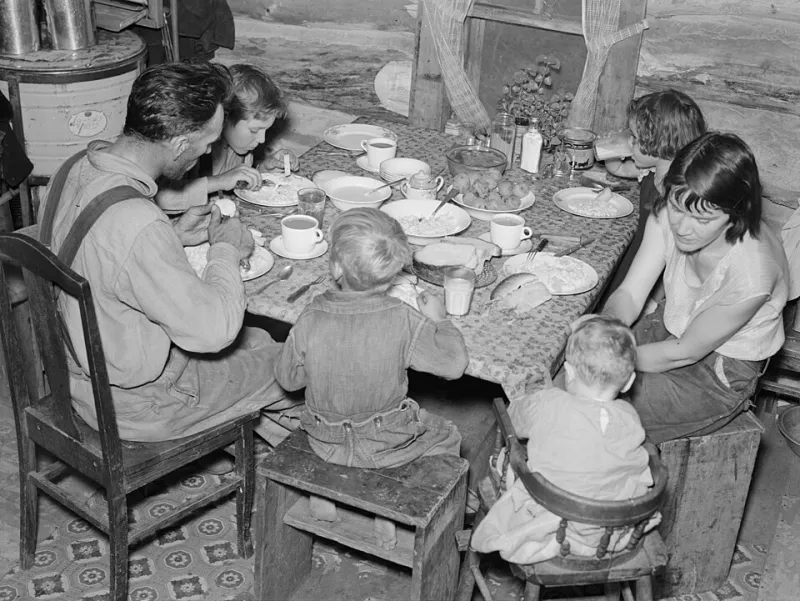
Photo: Russell Lee, Public domain, via Wikimedia Commons
Let's be honest about something: the concept of "dinner" has taken a beating in American family life. Between soccer practice at 5:15, the second-grader who melts down at 4:30, and the toddler who refuses everything orange, it's easier to hand out crackers at 3:45 and call it a bridge than to protect an actual mealtime. Do that every day for a year, and you've stopped having meals at all. You have a 14-hour grazing window with a couple of sitting-down events in the middle.
We're not here to blame anyone. The snack-ification of childhood happened for very understandable reasons — packed schedules, aggressive snack marketing, car seat logistics, and the simple fact that feeding kids constantly keeps the peace. But it's worth looking at what all-day grazing actually does, because the effects are more interesting than "snacks are bad."
What Grazing Does to a Kid's Appetite
Hunger is supposed to be a signal kids learn to read. When a child eats every 45 minutes — a goldfish here, a pouch there, a handful of pretzels in the car — their body never gets the chance to build real, recognizable hunger. And here's the counterintuitive part: kids who graze constantly are often more picky at meals, not less. They arrive at the table only mildly hungry, take two bites, declare themselves done, and the cycle restarts in an hour.
There's also a nutrition math problem hiding in the snack bag. Most shelf-stable kids' snacks — the puffs, the bars, the fruit snacks — are refined carbs with little protein or fiber. They're digested quickly, which spikes hunger again soon after. Meanwhile, the foods kids tend to eat at actual meals — the vegetables, the proteins — get crowded out by a stomach that's never empty and never full.
And then there's the family cost. If snacking is constant and unstructured, mealtimes stop being about connection and become a negotiation over food a child has already pre-empted. That's a recipe for the exact mealtime stress every parent dreads.
The Framework: Rhythm, Not Rigidity
If you want to rebuild structure, you don't need a feeding schedule worthy of a sleep-training book. You need a rhythm. Most children do well with something like: three meals and two to three scheduled snacks, spaced two and a half to three and a half hours apart. Between those windows, the kitchen is closed — kindly, boringly, without fanfare.
A few principles that make this survivable:
Snacks are mini-meals, not treats. A scheduled snack should have some staying power — apple with peanut butter, cheese and crackers, yogurt. A snack that's basically dessert guarantees the 90-minute hunger crash.
The kitchen-closed rule applies to everyone, and it's announced, not enforced with drama. "The kitchen opens again at 5:30" works far better than "no, you can't eat that." You're not being mean; you're being predictable. Kids adapt to predictability remarkably fast — usually within a week.
Expect the protest phase. If your family has been grazing for years, the first few days of structure will involve complaints. That's not evidence the plan is failing; it's evidence it's new. Hunger at a predictable time is not an emergency, and a child who eats dinner with genuine appetite is a child who eats more of the vegetables on the plate.
Build in flexibility on purpose. Road trips, birthday parties, sick days — structure should bend, not shatter. The goal is a default, not a prison. A family that has structured meals 80 percent of the time is winning.
The Part Nobody Says Out Loud
Here's the opinion part of this opinion piece: a lot of the grazing in American households isn't about hunger at all. It's about boredom, transitions, car rides, screen time, and emotional regulation — ours and theirs. Snacks have become the universal parenting tool for buying 10 quiet minutes.
We'd gently suggest that this habit costs more than it pays. When food becomes the answer to every fidget and whimper, kids lose the chance to experience boredom, to sit with mild discomfort, and to arrive at a meal genuinely hungry. Rebuilding meal structure is partly a nutrition intervention. It's also a chance to decouple food from entertainment — which, in a culture where ultra-processed snacks are engineered to be eaten mindlessly, might be the more important lesson of the two.
Start Small, Start Tomorrow
You don't have to overhaul everything. Pick one change: maybe it's a defined "kitchen hours" window in the late afternoon, or upgrading one snack from crackers to something with protein. Notice what happens at dinner within a week. For most families, the child who "never eats dinner" starts eating dinner — not because of pressure, but because hunger finally has room to show up on schedule.
Meals aren't just nutrition delivery. They're the rhythm of a family's day. It's worth protecting them.